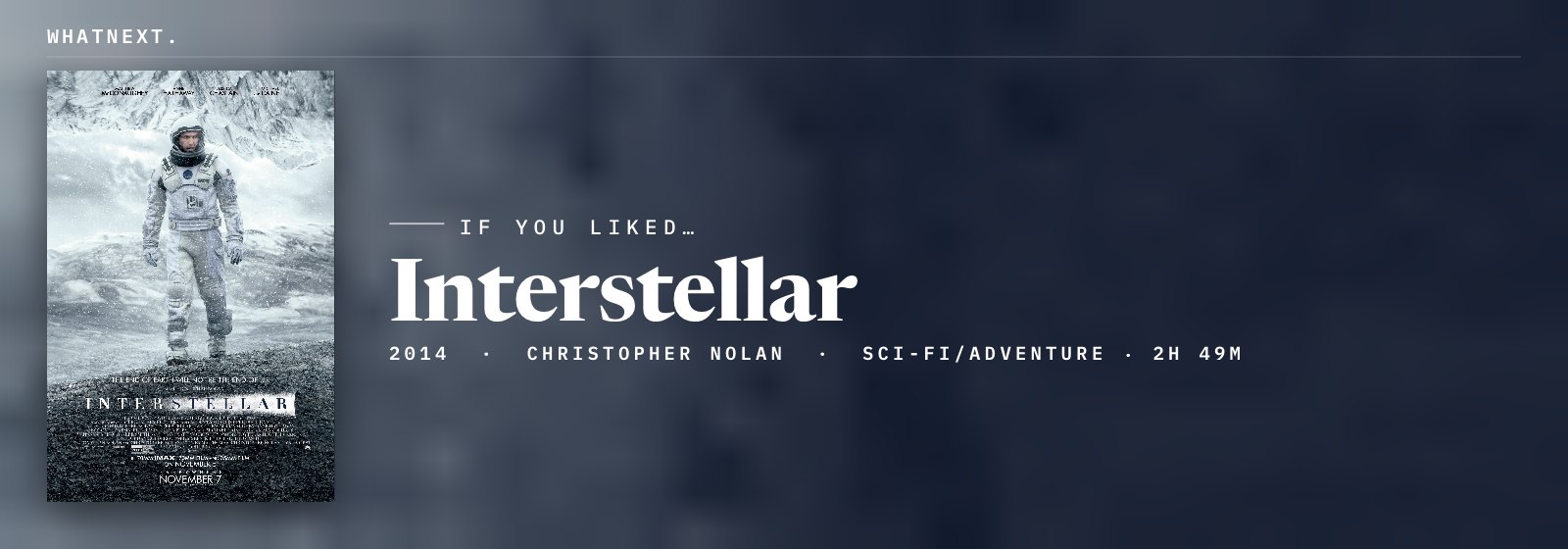
Interstellar works by making you feel impossibly small, then giving you a reason to care anyway: real physics, a family stuck on opposite sides of relativity, and a scale big enough to swallow a solar system without ever losing the two people at the center of it. That combination, hard science paired with an emotional core big enough to match it, is a specific taste, and it's not always an easy one to satisfy with the next big space movie that comes along.
WhatNext.'s recommendation engine used Interstellar as a seed and ranked its catalogue by similarity from there. These four were picked from that ranked list for sharing the same mix of scale, awe, and quiet emotional weight, rather than spectacle for its own sake.
The Four Picks
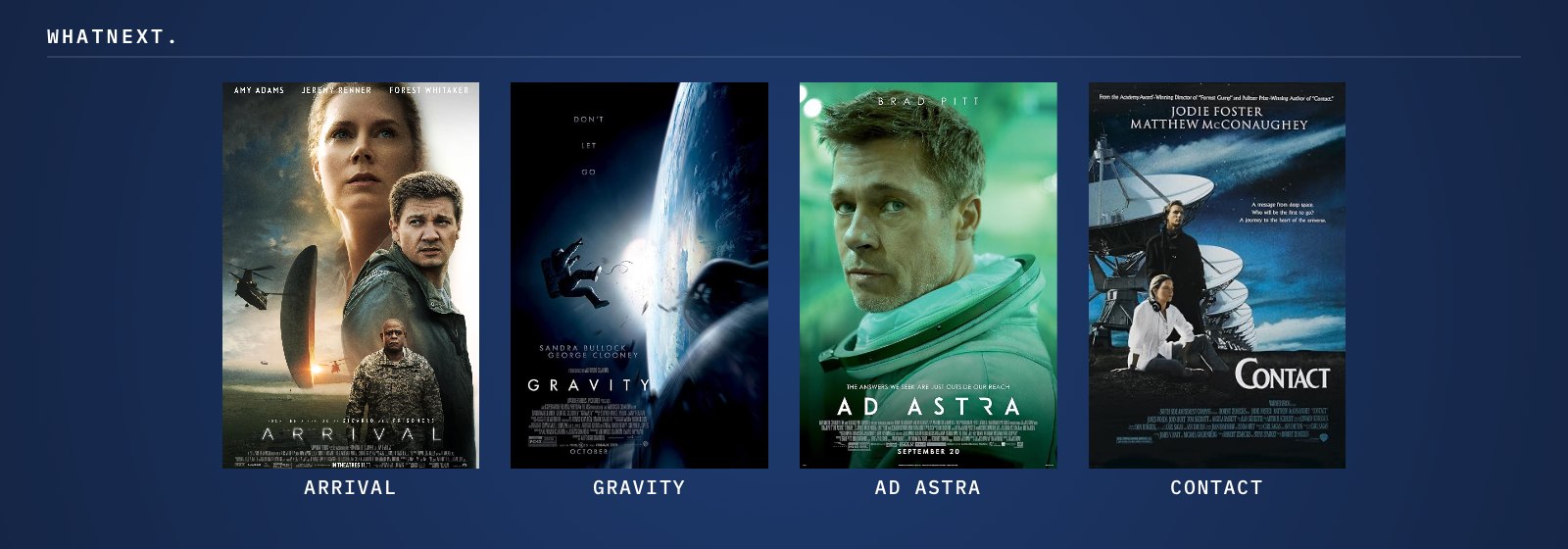
Arrival turns first contact into something closer to a meditation on time and memory than a thriller. A linguist is brought in to communicate with an alien vessel that's appeared without explanation, and like Interstellar, the science is the engine, but the ending lands on something personal, not a twist for its own sake.
Gravity takes Interstellar's galactic scale and narrows it all the way in: two astronauts, a damaged shuttle, and the physics of just staying alive in orbit. The tension comes from how little room there is for error, which makes the moments of actual awe (Earth from above, the silence of open space) land harder by contrast.
Ad Astra is a father-son story dressed as a space epic. An astronaut travels to the edges of the solar system chasing his father, who disappeared on a mission years earlier, and the film uses the vastness of space the same way Interstellar does: to make an intimate, personal story feel enormous.
Contact, based on Carl Sagan's novel, follows a scientist who picks up the first confirmed signal from another civilization and has to fight to be taken seriously about what it means. It's the most overtly hopeful of the four, closer to Interstellar's own ending than its middle: awe used to make a case for connection, not distance.
A few other titles were in the running but lost out on recognizability. Europa Report scored nearly as well as the picks above; Solaris (the 2002 Soderbergh/Clooney version) and The Wandering Earth landed a bit further down the list but still on the same scale-and-melancholy axis, the latter from a more action-forward angle. If the four above land, they're worth a look next.