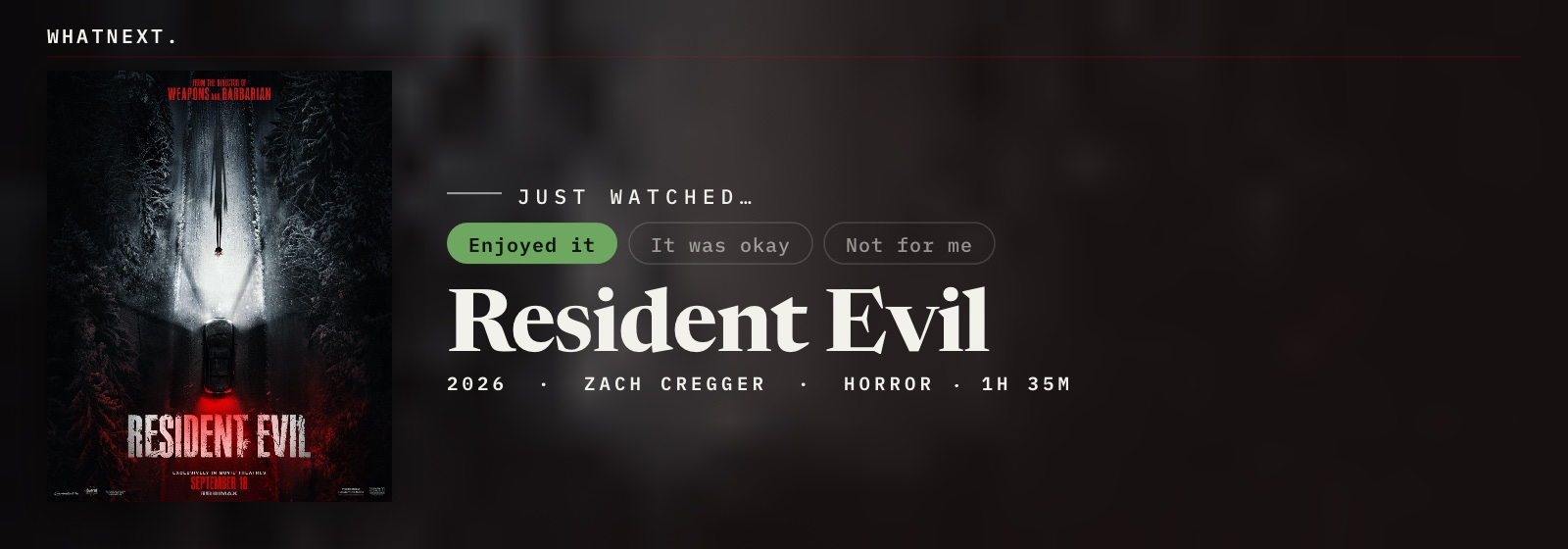
I am not typically a big horror person, but I grew up watching the original Resident Evil movies and spent plenty of late nights playing classic entries in the game franchise. After eight previous feature films wrestled with balancing cinematic momentum against authentic video game tone, Zach Cregger's Resident Evil (2026) arrives with a refreshingly stripped-down focus. Following his breakthrough with Barbarian and last year's breakout Weapons (where Amy Madigan earned the Academy Award for Supporting Actress), Cregger casts Austin Abrams as Bryan, an ordinary medical courier whose routine delivery drops him straight into the nightmare of a viral outbreak in Raccoon City. Instead of drowning the audience in franchise lore, martial-arts acrobatics, or corporate boardroom espionage, the movie commits to being a grounded survival thriller where darkness is heavy.
What Worked
The direction and atmosphere are where this film shines brightest. Cregger constructs an experience that turns truly tense around 10 to 15 minutes in, once the initial setup for the quest is established. The movie actually takes place mostly outside, so it is particularly impressive how he uses stark, low lighting to make an open road or a snowy field feel tightly claustrophobic and lonely. You feel the physical weight of Bryan being stranded in a place where help is not coming, even as the terrifying reality that he might not actually make it home does not really settle in until near the end of the film.
What impressed me most was how thoughtfully the production translated video game language into cinema without feeling gimmicky. We get brief, intense first-person perspectives that put you directly into Bryan's shoes, alongside the desperate rhythm of finding a firearm only to realize you have to search the room for loose bullets. One standout sequence captures this perfectly: an armed survivor starts out right alongside Bryan and gradually moves further and further away while Bryan stands frozen in place in true video game fashion, firing frantically at infected monsters before rounding a blind corner out of sight. The camera refuses to cut away, forcing Bryan to slowly follow into that darkened corridor to get something he needs.
The movie is also wonderfully self-aware about subverting video game tropes, especially the sacred cow of survival horror: the padlocked gate. Anyone who has played the games knows the absurdity of a tiny padlock stopping an entire journey in its tracks, or characters treating a two-foot gap between bars like an impassable invisible wall. Cregger turns these moments into running visual comedy without breaking the tension. In the first padlock encounter, the staging practically begs you to yell at the screen for Bryan to just gun the accelerator and ram his vehicle through. He actually does, and real-world vehicle physics immediately punishes the attempt. In the second encounter, he bypasses video game logic by simply squeezing his body through a narrow opening in the gate. It is a hilarious subversion, made even funnier when he immediately runs into a dead end on the other side and has to scout for an alternate route anyway, realizing he could have just looked around for a path from the start without bothering with the gate. That grounded humor extends to his weapons too: Bryan tries shooting padlocks at least three separate times across the film, watching bullets uselessly deflect off hardened steel before he finally gets one open on the third attempt.
Austin Abrams anchors the entire journey with a great, grounded performance. Bryan reacts to the unfolding terror like a real human being rather than an action hero, selling the panic, exhaustion, shock, and sometimes genuine annoyance of an everyday worker caught in an impossible situation. Crucially, Bryan is motivated by the belief that he is doing something genuinely noble. He does not actually know what is inside the cargo he was hired to transport. Carrying an insulated container with a strap, resembling the kind of cooler you see organs transported in on TV, he simply assumes it is a life-saving donor organ meant for an emergency patient. That assumed purpose gives him an earnest, sympathetic drive that keeps you rooting for him even as everything around him spirals out of control.
What Didn't Land
Where the film stumbles is in its foundational setup. Bryan is hired as an everyday courier for an urgent delivery, tasked with transporting this insulated container across state lines. While his personal belief that he is carrying a donor organ explains why he refuses to abandon the cargo, the broader mechanics of the assignment fall apart under scrutiny. Why an ordinary courier was entrusted with this critical, high-stakes package in the first place is what the movie tries and, in my opinion, fails to explain through rushed dialogue later in the story. It is hard to buy why the destination was so far out, or why Bryan did not simply turn around at the first sign of trouble. Double pay might get someone to take an undesirable weekend shift, but it hardly justifies driving deeper into an active disaster zone. With Bryan traveling largely on foot for most of the movie, the logistical question of how he manages to reach the destination before anyone else feels noticeably strained.
The climax also suffers from narrative clutter. While I appreciate the sense of chaotic confusion and desperate hope the filmmakers were aiming for in the finale, the character decisions in the last stretch begin to feel nonsensical. When panic takes over the screen, the crisp spatial logic that made the earlier set pieces so effective gets somewhat lost in the noise.
Final Thoughts
Despite those third-act script wobbles, Zach Cregger finally achieved what eight movies before him could not: he made a genuinely good, atmospheric Resident Evil adaptation.
Franchise purists might take issue with the fact that these infected creatures are not slow, traditional shambling zombies, or that the story centers on an original protagonist rather than legacy heroes like Leon Kennedy or Claire Redfield. But for my taste, it captures the exact dread, resource scarcity, and loneliness that defined the best moments of the games. When I posted my initial reaction on TikTok, I logged it firmly as a "Liked it" verdict. It feels like we have entered a genuine renaissance for video game adaptations, where studios and directors finally treat the source material with creative respect, and I am loving it.
Stray Observations
- It is easy to overlook amid all the gore and kinetic set pieces, but at its core, the movie is essentially one big cat-and-mouse game right up until the end.
- The near-total absence of a traditional supporting cast was a brave choice, but it pays off by intensifying the isolation. Bryan has no squad to back him up.
- The infected are definitely not standard garden-variety zombies, but that tracks with how the video game franchise itself has evolved over the years, more than just in creature designs but in the actual creatures themselves.
- As a self-confessed scaredy cat, there were several points during the tensest stealth sequences where I legitimately had to cover my eyes.
If You Liked This, Try These
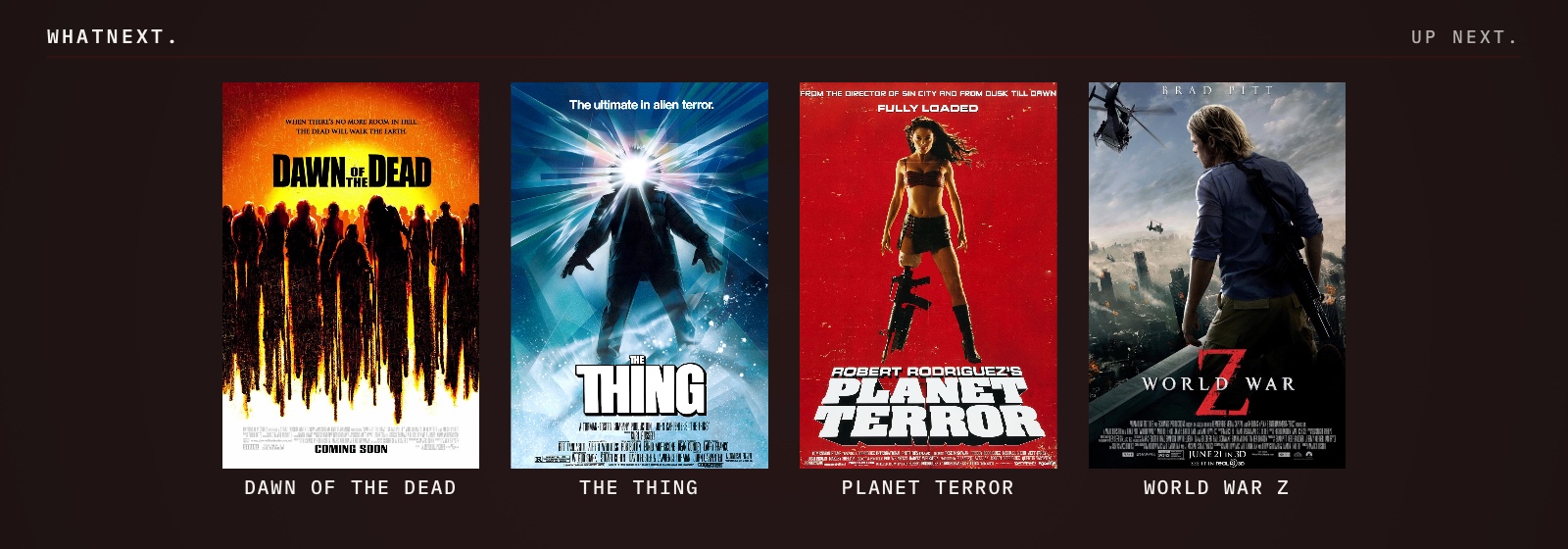
WhatNext.'s recommendation engine used Resident Evil as a seed, searching the catalogue for movies that share its viral outbreak tension, survival stakes, and claustrophobic dread. These four picks capture different shades of that same desperate energy:
Dawn of the Dead (2004) is the natural companion for anyone who enjoyed the kinetic terror of fast, relentless infected. Zack Snyder's remake of George A. Romero's classic traps a ragtag group of survivors inside a suburban shopping mall, balancing high-octane barricade defense with the agonizing reality of a society collapsing overnight.
The Thing (1982) remains John Carpenter's absolute pinnacle of isolated paranoia. While it trades an urban quarantine for an Antarctic research outpost, its shape-shifting alien threat mirrors the physical horror of biological contagion where anyone in the room could already be compromised.
Planet Terror (2007) tackles bio-weapon viral outbreaks from a grittier, pulp-heavy angle. Robert Rodriguez delivers practical monster effects, quarantined small-town chaos, and relentless survival momentum that echoes the creature-feature fun buried inside the horror.
World War Z (2013) takes the viral outbreak premise and widens the camera to a terrifying global canvas. If the initial collapse in Raccoon City left you wanting to see how rapid infection overwhelms modern infrastructure on a grander scale, this remains one of the most intense depictions of sheer viral panic ever put on film.
A few runners-up from the same recommendation pool scored high on raw similarity and are well worth checking out: Wyrmwood (2014) brings wild indie ingenuity to post-apocalyptic outbreak survival, Alien: Romulus (2024) matches the dark industrial isolation of bio-engineered horrors, and Flight of the Living Dead (2007) proves how fun a confined outbreak premise can be.