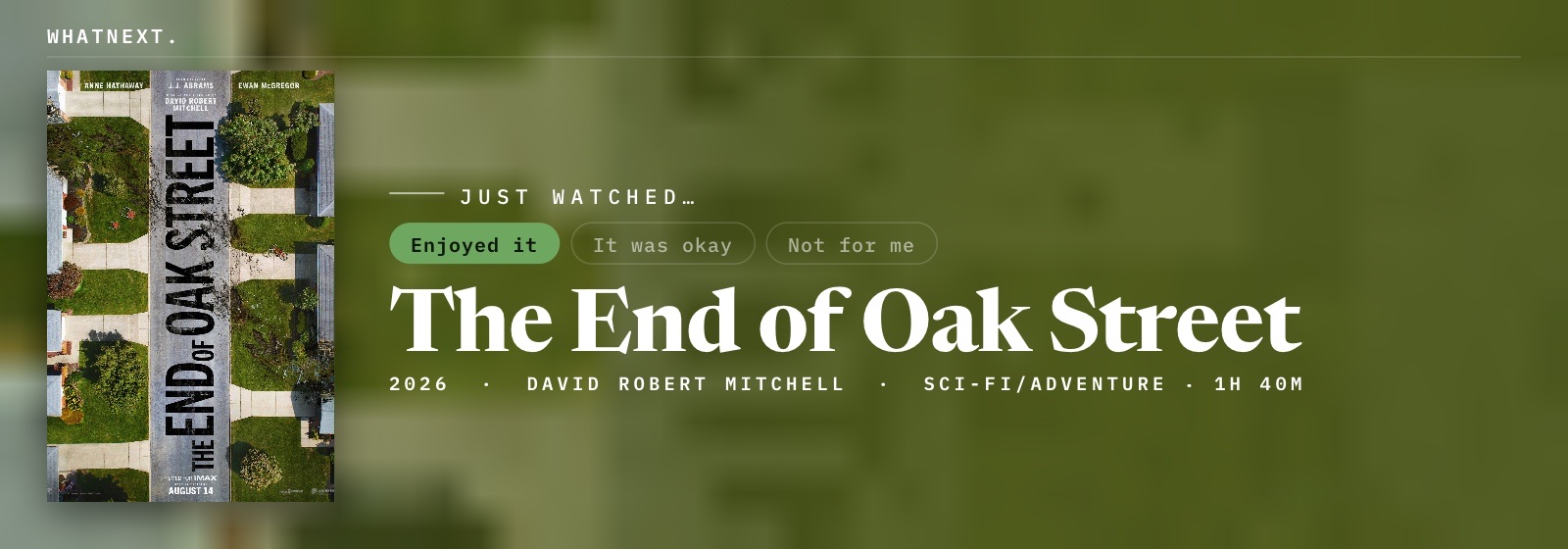
The pitch for The End of Oak Street is almost embarrassingly simple, and that simplicity is exactly why it works: one ordinary suburban block, pulled out of 1982 without warning, and dropped into the age of dinosaurs. No portal mythology to explain, no chosen one, just a cul-de-sac full of families figuring out how to survive with whatever happens to already be in their garages. David Robert Mitchell directs, and it's not a huge leap from his earlier work. It Follows turned quiet suburban streets into something creeping and unsafe, and The End of Oak Street does the same thing by more literal means, swapping a supernatural threat for a prehistoric one and letting the neighborhood itself become the thing under siege. Anne Hathaway and Ewan McGregor lead as the parents trying to hold their family together through it.
What Worked
The movie doesn't waste your time getting there. It's efficient about setup and gets to the actual danger fast instead of stalling on the "how did this happen" question, and that mystery-box instinct turns out to be one of the best choices here: it never stops to explain what happened or how the street ended up in the past. It's better for it: the not-knowing is part of the dread. The stakes feel real throughout, and there's a genuine surprise late in the film that raises them further right when the story could have started coasting.
The dinosaurs themselves read as a real threat to everyone on screen, not just background spectacle, and the film's most nerve-wracking stretch isn't even a dinosaur at all: a scene with a snake loose inside the house, which plays the same "nowhere is actually safe" idea in miniature and lands harder for it. The family dynamics mostly hold up too. Outside of one plot-motivated decision from the son (more on that below), the way this family reacts to what's happening to them feels grounded and earned rather than written to hit story beats.
What Didn't Land
The back half is where it loses ground. The film is oddly vague about scale: it's genuinely hard to tell how much of the area actually got pulled into the past, and at points that ambiguity tips into feeling like the filmmakers made the affected zone bigger than the story can actually use. Even the title undersells it: The End of Oak Street suggests one block, but what actually gets pulled back in time reads as bigger than that, and the movie never quite settles on which scale it's telling. The supporting cast is thin to the point of being surprising: for a movie built around a whole neighborhood getting stranded together, there's no real scene of that close-knit community banding together to survive; it stays almost entirely with one family.
The son's early decision, the one that actually kicks the plot into motion, reads as existing purely to get the story moving rather than as something the character would plausibly do, which is a rough note to hit early. And the ending feels like a reshoot: contrived in a way that suggests the film may have originally been headed toward a less flattering place for its lead, walked back into something safer that still lands a little flat as delivered. The scene where McGregor saves Hathaway, late in the film, is a strong beat on its own, but it sits inside an ending that doesn't quite earn its own turn.
Final Thoughts
So: liked it, not loved it. The End of Oak Street gets the fundamentals right: tight pacing, real stakes, dinosaurs that actually feel dangerous, a family that reacts like people rather than plot devices. It then loses some of that goodwill in a back half that overreaches on scale, thins out the supporting cast right when it should be widening, and closes on a note that plays more like a patch job than an ending. It's a solid pick for a Friday night, not a new genre landmark, and that distinction matters.
Zoom all the way out and it's a pretty good dinosaur movie, honestly the most I've enjoyed one in a while. Not the best the genre has ever produced, but if dinosaurs and survival are already a taste worth returning to, this one is worth the watch. It's working from the same ground Jurassic Park staked out.
Stray Observations
- There are maybe one or two genuine dino jump scares and that's about it; this isn't a movie leaning on cheap scares to pad its runtime.
- There's been some online chatter about certain dinosaurs showing up outside their actual time period. Fair, but paleontological accuracy isn't really the bar this movie is trying to clear, and it didn't bother the watch at all.
If You Liked This, Try These
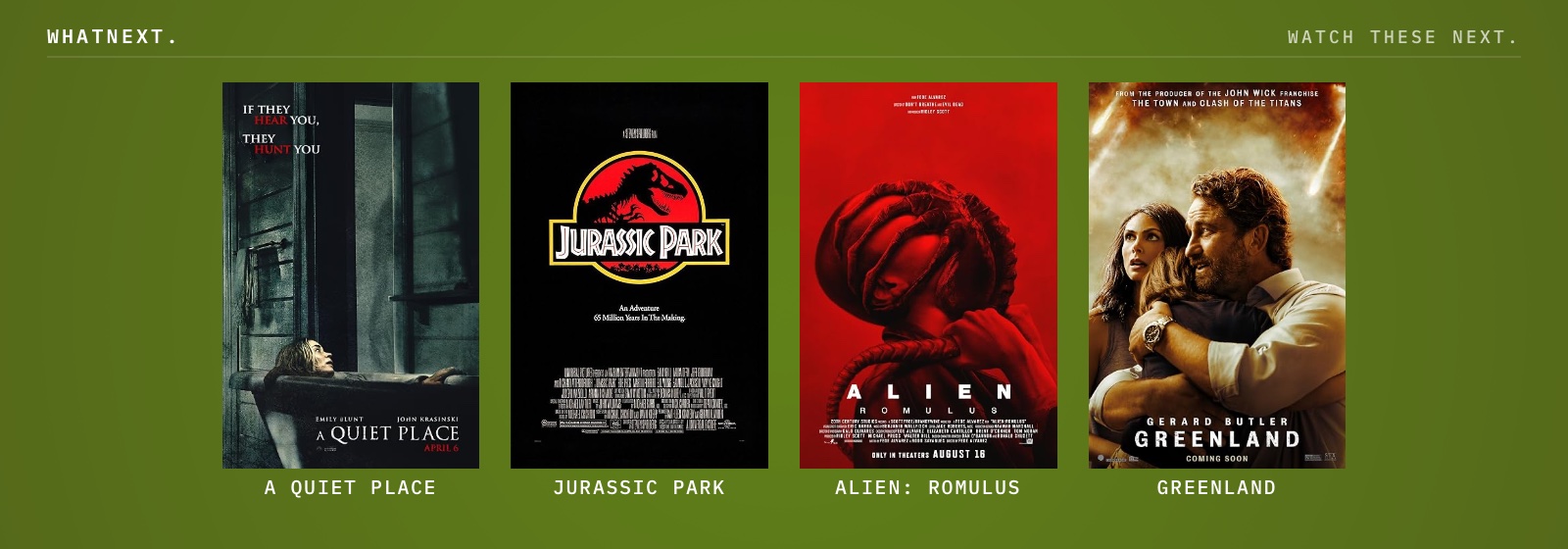
Speaking of that company: WhatNext.'s recommendation engine used The End of Oak Street as a seed and ranked its catalogue by similarity, filtered to titles that actually share its survival and family tags rather than just "has a dinosaur in it." The four picks below split across two angles on the same idea, ordinary people against a prehistoric or extinction-level threat, and family units trying to survive together against overwhelming odds.
Jurassic Park is the obvious reference point, and for good reason: it's still the high bar for "ordinary people against dinosaurs," built on patience and real dread before it ever lets the spectacle take over, and with a wider ensemble actually working together against the threat, the exact thing The End of Oak Street leaves on the table.
A Quiet Place trades dinosaurs for something just as unexplained and just as dangerous, and leans even harder into the family-first instinct that's Oak Street's best quality. It's proof that a survival thriller can run almost entirely on the stakes between the people trying to protect each other, with barely any exposition at all.
Alien: Romulus pushes the same "ordinary people, prehistoric or alien threat, nowhere safe" idea into a colder, more claustrophobic register. If the neighborhood-under-siege feeling of Oak Street worked for you, this is the same pressure with the walls closing in even tighter.
Greenland drops the creature entirely and keeps everything else: a family trying to survive an extinction-level event together, with the tension coming from logistics and hard choices as much as from the threat itself. It's the closest match here to Oak Street's actual emotional center, a family holding together while the world falls apart around them.
A few other titles from the same ranked list came close but didn't make the final four. Jurassic World Rebirth and The Lost World: Jurassic Park both scored well on raw similarity, staying closer to Oak Street's literal dinosaur premise without adding much beyond it. The Wandering Earth sits nearby too, trading dinosaurs for a planet-scale disaster but keeping the same "ordinary people, overwhelming threat" shape. Any of the four picks above are worth going to first, but these are close behind if you want more.