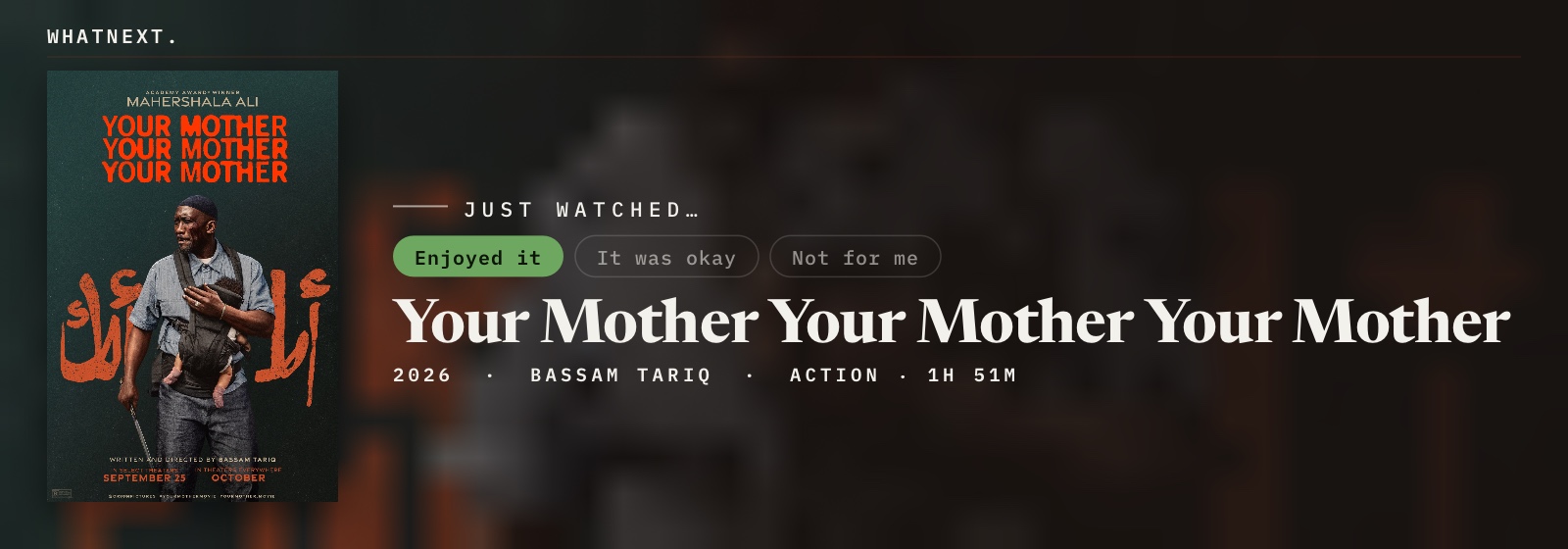
Bassam Tariq's Your Mother Your Mother Your Mother (2026) sets up what could easily have been a generic, adrenaline-fueled action vehicle and turns it inside out. Distributed by Amazon MGM Studios after premiering at TIFF, the film stars Mahershala Ali as Latif, a devout Muslim hitman in Houston striving to balance his illicit trade, his spiritual commitments, and the demands of parenthood. When his wife passes away, Latif is abruptly thrown into navigating acute family grief while trying to insulate his children from the violent consequences of his livelihood. Rather than staging an endless succession of shootouts, Tariq approaches the material with deep sensitivity, centering the story on the emotional fallout of loss and the quiet power of a community closing ranks to protect its own.
What Worked
The acting across the ensemble is superb. Mahershala Ali commands the screen with quiet authority and vulnerability, but the real revelation is Latif's relationship with his eldest daughter. Her standout, emotionally grounded performance anchors the film during its most vulnerable moments. The writing also weaves in disarming, organic humor throughout the dialogue, allowing the family to breathe naturally rather than drowning under relentless misery.
Tariq's direction feels remarkably intimate, perfectly calibrated for a story that thrives on proximity rather than grand spectacle. The camera lingers on small domestic rituals, conveying the texture of a real home and an actual neighborhood. The broader community dynamics feel fully realized, showing how Latif's extended circle and local religious peers band together to support his grieving household instead of treating them like isolated genre archetypes.
The script shines brightest in its bookends, boasting a particularly confident opening and a moving conclusion. Latif gets his targets through Mike Mahmoudi, a business owner who supplies contract hits and cleans up when necessary. The central conflict ignites around Mike's nephew, Hatty, who runs an adult video operation out of his mansion. A fanatical religious leader named Hwan Yoon (played by John Cho) mounts a crusade against the adult industry, convinced Hatty's site is a front for human trafficking, an accusation the film leaves unresolved. When Mike asks Latif to eliminate Hwan Yoon to protect Hatty, Latif firmly rejects the job, determined to step away from contract killing and focus on his grieving household. Domestic necessity pulls him right back in. Latif also has an infant daughter who may be allergic to formula, sending him alongside Hatty to locate a woman from Hatty's operation who had nursed the baby the night before. But when they arrive at her former workplace, they discover the strip club has already been "liberated" into a pop-up church by Hwan Yoon's followers. Unbeknownst to Latif and Hatty, the woman has joined Hwan Yoon's fold, turning a desperate search for breast milk into an unexpected confrontation that drops Latif right into the orbit of the very target he refused to kill. It pays off early worldbuilding about zealous religious groups reclaiming local commercial spaces in a funny, natural, and immediately compelling way.
Equally compelling is how authentically the screenplay depicts the psychology of grief, particularly through the lens of fractured faith. Latif's daughter visibly slips into parentification, quietly assuming domestic caretaking duties that no child should have to bear, but her grief also manifests in turning away from her religion. Her struggle with faith feels painful and deeply honest for someone her age, searching for answers in the face of an unbearable, senseless tragedy. Meanwhile, the younger son clings stubbornly to familiar daily routines while acting out for attention, and Latif attempts the impossible feat of carrying every practical and emotional burden alone. Yet Latif's own spiritual foundation is cracking: at his wife's funeral, he noticeably refuses to bow during prayer out of raw anger, and later in the movie he lashes out when his son asks to pause and pray. Watching both father and daughter independently wrestle with their beliefs gives the family tragedy a profound emotional weight.
What Didn't Land
Where the film falters is in its middle act, where the narrative momentum begins to drag and Latif's decision-making turns frustratingly inconsistent. After escaping the church confrontation, Latif begins making choices that defy basic survival logic. He takes his family out to a diner at night for a fast-breaking meal while active threats remain unresolved, returns home before confirming whether the perimeter is safe, and fails to give fair warning to his mosque despite knowing he previously registered their address on record.
A pivotal confrontation at that diner highlights this narrative friction. When hostile pursuers arrive during the meal, Latif essentially stands by and allows them to abduct Hatty into the night without putting up meaningful resistance. The sequence feels awkward and unearned. Had that abduction unfolded earlier during the strip club turned church chaos, the narrative could have arrived at the exact same dramatic junction with far tighter storytelling economy.
The conclusion, while emotionally resonant in spirit, also suffers from a somewhat confusing execution. The filmmakers clearly knew the thematic destination they were aiming for, but the abrupt shift in perspective leaves a few logistical questions dangling.
Final Thoughts
Despite those mid-film structural wobbles and questionable protagonist detours, Your Mother Your Mother Your Mother remains a genuinely good, thoughtfully observed family drama. It succeeds because its heart is firmly rooted in the lived reality of its characters, refusing to sacrifice authentic community tenderness for easy genre thrills. When I posted my initial reaction on TikTok, I logged it firmly as a "Liked it" verdict. It is a messy film in spots, but one whose emotional sincerity easily outweighs its script flaws.
Stray Observations
- Giancarlo Esposito has officially entered Samuel L. Jackson territory, popping up in seemingly every third movie released these days, and his presence is always an asset.
- I really respected that the film never felt the urge to over-explain its world or supply neat expository answers to every character background.
- Watching the creative chemistry between Mahershala Ali and Bassam Tariq makes me genuinely mourn the fact that we will never get to see their canceled Blade project.
If You Liked This, Try These

WhatNext.'s recommendation engine seeded from Your Mother Your Mother Your Mother, searching the catalogue for stories that balance criminal pressure with fierce parental dedication and raw grief. These four picks reflect different facets of that same emotional conflict:
Shoplifters (2018) explores family devotion formed outside biological ties, set against the backdrop of petty criminal survival in Tokyo. Hirokazu Kore-eda captures the same warm, lived-in domestic intimacy that makes Tariq's film sing, demonstrating how a makeshift household constructs its own moral boundaries to shield vulnerable children from an indifferent world.
A Thousand and One (2023) captures fierce, desperate motherhood against systemic poverty and displacement in New York City. A.V. Rockwell's drama mirrors the relentless parental drive to protect a child from institutional rot, showing how a parent's past mistakes inevitably catch up to their present devotion.
Mother (2009) pushes parental loyalty into its darkest psychological corners. Bong Joon-ho directs a gripping Korean thriller about a desperate mother who undertakes an obsessive, dangerous personal investigation to clear her intellectually disabled son of a brutal murder charge, testing the absolute limits of familial devotion.
Three Billboards Outside Ebbing, Missouri (2017) balances blistering grief, community friction, and pitch-black humor following an unimaginable family tragedy. Martin McDonagh's drama follows a grieving mother who refuses to let her daughter's unsolved death be swept under the rug, challenging local authority with fearless determination.
A few runners-up from the same recommendation pool scored high on raw thematic similarity: Lila & Eve (2015) follows two grieving mothers who turn to vigilante justice to avenge their children, while Fingers (1978) offers an intense character study of a man painfully split between his artistic passions, family loyalty, and violent criminal debts.