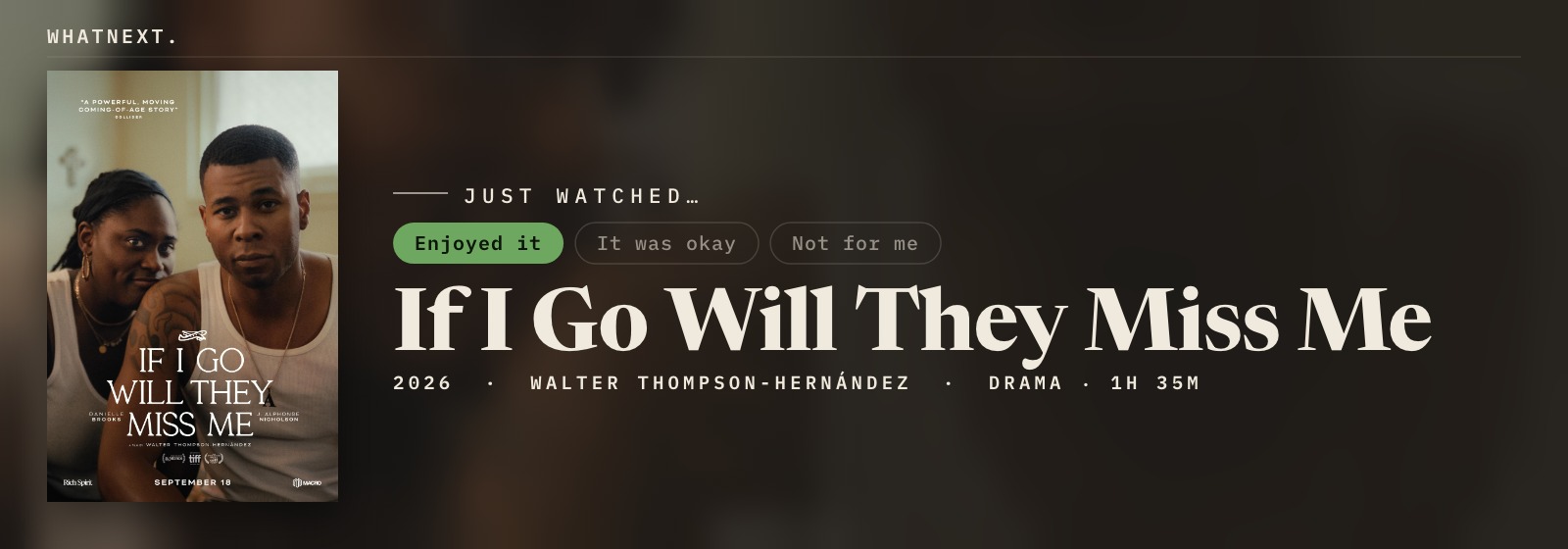
Walter Thompson-Hernández's If I Go Will They Miss Me (2026) expands his 2022 Sundance award-winning short into an intimate, dreamlike exploration of family reentry and childhood perception. Set against the concrete backdrops and sun-soaked avenues of Watts, California, the film centers on twelve-year-old Lil Ant (Bodhi Dell) as his estranged father, Big Ant (J. Alphonse Nicholson), returns home after serving time in prison. Rather than turning the family's fraught reunion into a conventional kitchen-sink melodrama, Thompson-Hernández couches their reconciliation in lyrical magical realism. Jetliners roar continuously overhead on their descent toward Los Angeles International Airport, Lil Ant pictures his parents as mythic gods of the sea and storm, and ethereal visions of neighborhood youth drift past like silent phantoms. The result is less a standard linear narrative and more of a moving portrait, observing its characters with quiet, non-judgmental grace.
What Worked
The film's most striking virtue is its non-judgmental stance toward its characters and their flaws. Thompson-Hernández refuses to moralize or package his characters into easy archetypes. Instead, the opening sequences patiently establish the distinct emotional fault lines running through the household, giving each person's internal reality equal weight.
Big Ant's struggle to reconnect with civilian life and establish a bond with a son who barely remembers him is handled with aching vulnerability by J. Alphonse Nicholson. But the film's emotional anchor belongs to Lo, played with breathtaking precision by Danielle Brooks. Brooks consistently brings her A-game to every project, and her performance here is a masterclass in quiet boundaries. She embodies a woman forced to reconcile the partner she once loved with the troubled man standing before her. While she initially makes excuses for Big Ant and stays deeply empathetic to his difficult transition out of prison, she eventually realizes she cannot let him derail the stability she fought to build. Her choices are guided by maternal self-preservation, doing what is necessary for herself and her children rather than indulging false nostalgia.
Lil Ant's arc is equally compelling. Bodhi Dell captures the fragile, heartbreaking dissonance of a boy caught between memory and reality. Lil Ant has spent years constructing a towering, mythologized version of his absent father, and reconciling that heroic illusion with the quiet, broken human being who returns is painful. The contrast between Lil Ant's gentle innocence and the harsh urban realities of Watts gives the film a tender, protective pulse. Rounding out the ensemble, Myles Bullock delivers strong work as Big Ant's loyal best friend. He provides the kind of friendship every struggling man needs: someone unafraid to call Big Ant out on his missteps without cruelty or condescension, while quietly showing up to support Lil Ant whenever stability falters.
What Didn't Land
Where If I Go Will They Miss Me falters is in its narrative cohesion. At times, the film leans so heavily into its abstract metaphors and surreal interludes that the emotional immediacy slips away. The allegorical imagery of Greek deities and neighborhood apparitions occasionally detaches from the story, feeling like decorative stylistic flourishes rather than organic extensions of Lil Ant's interior life.
The storytelling also leaves key contextual details frustratingly vague. Big Ant's incarceration history is never clearly defined: it is difficult to tell whether he has spent years cycling in and out of the penal system or if this was one continuous sentence. That ambiguity dulls the weight of his reentry, leaving viewers guessing about the specific habits and history straining his domestic life.
Compounding this, the narrative drags considerably across its middle act. The story wanders without clear momentum, losing urgency as scenes drift into one another without dramatic progression. Part of this stems from an inconsistent narrative point of view. Lil Ant provides the initial framing, but the perspective frequently shifts away from him to observe adult conflicts he has no part in. Had Thompson-Hernández anchored the entire film strictly through Lil Ant's subjective perspective, the dreamlike realism and emotional focus would have felt far more unified.
Finally, depicting characters with unsparing realism carries a delicate creative risk: sometimes, genuine human flaws make characters difficult to root for. While it is easy to empathize with Big Ant's circumstances on paper, his stubborn refusal to communicate with anyone around him can make spending time with him an exhausting, isolating experience.
Final Thoughts
Despite its pacing lulls and narrative detours, If I Go Will They Miss Me remains an imaginative, visually poetic work. It is an ambitious debut that treats a fractured community with deep tenderness, guided by remarkable acting across the board and an unforgettable turn from Danielle Brooks. When I logged my initial reaction on TikTok, I gave it a clear "Liked it" verdict. It may stumble in its structural choices, but its visual soul and empathetic core make it a worthwhile theatrical experience.
Stray Observations
- Jenn (played by Bre-Z) gets an unseen going-away party, though where she actually goes remains unclear.
- Big Ant having an affair with someone in the same complex is wild.
- Big Ant and Lo also have an older daughter who had an easier time reconnecting with him, but outside of appearing in a few scenes and getting straight A's, the plot does not give her much to do.
If You Liked This, Try These

WhatNext.'s recommendation engine seeded directly from If I Go Will They Miss Me, looking across the catalogue for films that explore the emotional resonance of fractured fatherhood, childhood innocence, and urban coming-of-age portraiture. These four selections reflect different sides of that delicate balance:
Moonlight (2016) shares the same lyrical, impressionistic approach to Black youth and vulnerability in an urban setting. Barry Jenkins directs with a poetic visual palette that mirrors Thompson-Hernández's tender aesthetic, observing how young men construct defenses to survive an environment that rarely affords them room to be soft.
Yi Yi (2000) is Edward Yang's patient, multi-generational family chronicle examining domestic life through the watchful eyes of young Yang-Yang. Like Lil Ant, Yang-Yang observes the private grief and compromises of the adults around him with quiet, uncorrupted curiosity, turning ordinary domestic routines into profound cinema.
Aftersun (2022) navigates the painful gap between childhood recollection and adult understanding. Charlotte Wells captures a young daughter trying to piece together the loving yet fractured psyche of her struggling father, echoing Lil Ant's journey of reconciling a parent's vulnerability with the myth constructed in memory.
The Confirmation (2016) grounds the father-son dynamic in a quiet, working-class weekend. Bob Nelson's drama follows an unreliable, recovering father spending a pivotal few days with his son, capturing the awkward, bittersweet reality of a parent trying to be dependable after years of broken trust.
For another rich exploration of myth and family reconciliation, Tim Burton's Big Fish (2003) serves as a great bonus pick, following an adult son who must sift through his father's tall tales to uncover the vulnerable truth underneath. During curation, Richard Linklater's Boyhood (2014) and Céline Sciamma's Petite Maman (2021) also scored strongly in our engine's family-focused pools, showing how cinema continually finds fresh ways to bridge the gap between childhood fantasy and domestic truth.