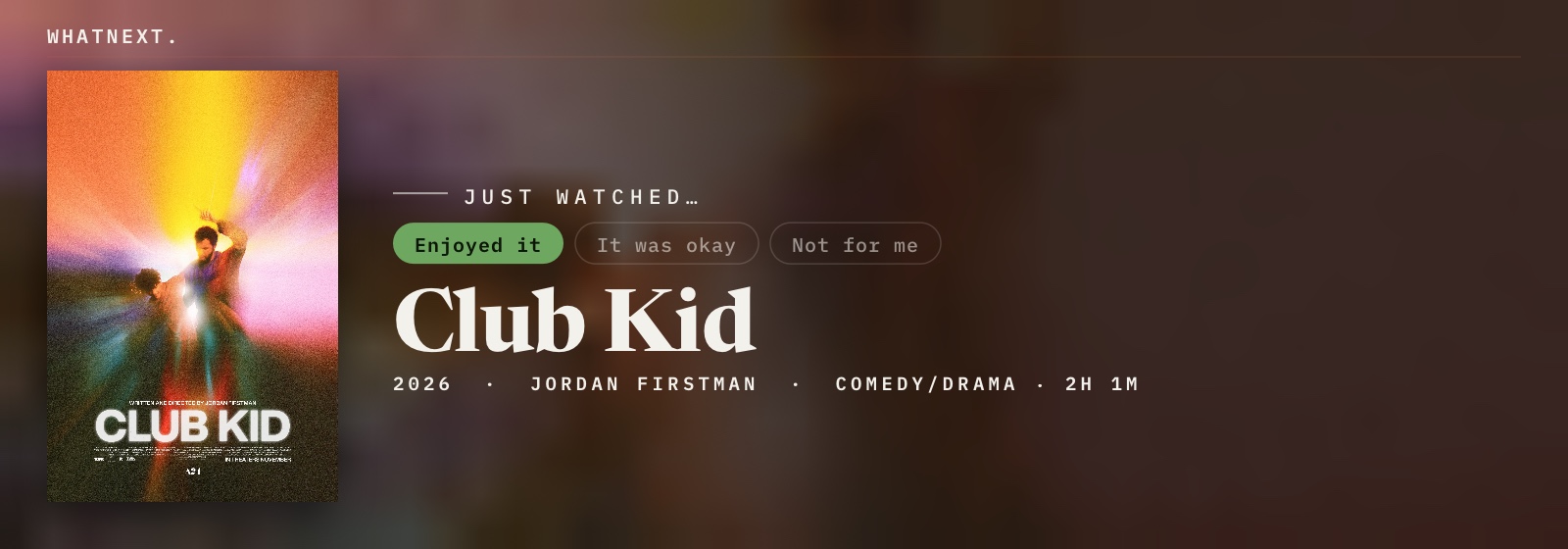
I basically went to see Club Kid (2026) on a whim. After catching the trailer in front of You Can See Everything, I bought a ticket for an 11 p.m. showing about 15 minutes before showtime, expecting it to just be a modern-day Big Daddy. It turned out to be so much more than that. Written and directed by Jordan Firstman in his feature directorial debut, the A24 comedy-drama stars Firstman as Peter, a thirty-something gay underground party promoter in New York City whose chaotic lifestyle is upended when he unexpectedly learns he has a 10-year-old son, Arlo (Reggie Absolom), from a hazy encounter at a party shown in an early scene of the movie.
What Worked
Right from the start, this is a genuinely funny movie filled with funny characters. The scene where Peter learns about Arlo for the first time is a particular standout. Edison (Kirby Howell-Baptiste) chaotically drifting around the apartment, making her points while asking for drugs and offering to make tea in the exact same casual manner before heading out to party, was hilarious. It establishes the humor early on as coming directly out of the chaotic, off-kilter reality of Peter's world rather than feeling like staged punchlines.
The direction and cinematography are great as well. The setting is clearly New York City and unmistakably NYC-coded, but it never overwhelms the narrative or becomes its own overbearing character the way the city does sometimes in indie films. In particular, the movie focuses on the queer nightlife scene, and while it features plenty of drug use and alludes to sex, it never feels judgmental in its portrayal. The party scenes themselves are particularly immersive: Adam Newport-Berra's camera leans into heavy darkness and quick flashes of light that make it hard to make out some details, capturing that sensory disorientation so well that it feels like you are right there at the party yourself. Through all of that nocturnal atmosphere, the movie is remarkably well paced; I never felt bored or felt that the story was dragging.
What really anchors the emotional core of the film is the development of the relationship between Peter and Arlo. It is handled really well, especially because it doesn't make Peter seem like a completely different person the moment he becomes a dad. His transition into fatherhood is gradual, and even as he begins taking responsibility, it just feels like a new version of the character we have been watching from the beginning. The screenplay also does a great job planting small seeds early on that pay off later. A stray Venmo charge is obviously going to come back to bite Peter down the line, while a shared Spotify playlist becomes a sweet, understated way for father and son to remain connected.
That gradual personal growth gives Jordan Firstman the runway for what is easily his best turn to date. Whenever I see him, he kind of plays a different flavor of the same character, usually popping up in supporting comedic roles where he riffs on that familiar persona. Seeing him take on genuine dramatic weight as a lead actor was a revelation. He balances the comedic self-absorption with real tenderness, and after watching him carry this film, I know he should be doing more dramatic leading roles.
The climax of the film was really well done. You can see how profoundly the experience with Arlo has changed Peter, but ultimately he cannot quite outrun some of his past decisions. That tension comes to a head when Sophie (Cara Delevingne) decides to call Child Protective Services. Sophie calling CPS, while incredibly cruel and selfish, did shine a light on how much Peter didn't really have all his ducks in a row. (Although, I'm not entirely sure how one does find out if a new child is in the country legally, but that is why there's the internet: "let's research mamas.") Even when Peter's world comes crashing down around him, he genuinely grew from the experience, and maybe that is what matters.
Because every piece of that journey is earned, the ending felt spectacularly written. It is bittersweet, teed up from the initial chaotic introduction and the way Peter lived his life, straight through to Sophie's actions. Ultimately, it is hard to disagree with the court's decision: Arlo needs stability, and while Peter was actively getting his life together, he didn't really have that yet (and while the court-ordered no-contact restriction felt harsh, that might just be a legal reality). What makes the courtroom scenes so devastating, though, is how every thread of the movie converges in that final phone call, where Firstman manages to play "happy to hear his voice," "relieved he's okay," and "sad he's not there" all at once before breaking down afterward. It is a completely heart-wrenching note to go out on, and the reason all the earlier comedy and chaos land with so much weight in hindsight.
What Didn't Land
Honestly, there was nothing major that missed the mark for me, so any criticisms here are strictly nitpicks. Because Arlo is never shown attending school during his stay, I am assuming the story mostly takes place over the summer. There is a short scene where Peter tries to enroll Arlo and hits a wall because he does not have all the information or paperwork, and the movie never really follows up on it. In a way, that dropped thread actually reinforces my point above about Peter not having all his ducks in a row, because had he followed through on getting Arlo enrolled, he might have uncovered the immigration circumstances before Sophie forced the issue.
Along those same lines, it was a little unclear exactly how long Arlo was actually with Peter. In the end, I don't think that timeline ambiguity really matters to the emotional impact of the story, though it was a small detail that left me wondering about the passage of time.
Final Thoughts
I laughed, I cried, and I smiled. What a ride this was. As a feature directorial debut, Club Kid completely took me by surprise, balancing genuinely funny, chaotic New York energy with a bittersweet ending that refuses to hand its characters an easy way out. Between Firstman proving he belongs in dramatic leading roles and a script that lets Peter grow without magically rewriting who he is, it might just be the best movie I have seen this year. When I logged my initial reaction on TikTok, I gave it a solid "Liked it" verdict, and sitting with the film afterward has only deepened how much it worked for me.
Stray Observations
- Why did Peter keep ghosting his friends? It happened early on with Devon (Nigil Whyte) and then again with Saffron (Saturn Risin9), where they seem close and then he won't speak to them for a prolonged period of time.
- When Arlo meets Peter's friends for the first time, I immediately thought of the scene in Adults where Paul Baker asks, "What is the spectrum of your language?"
- I kept waiting for the reveal that Peter wasn't actually Arlo's father, and I am glad the movie didn't go in that direction.
- Even if the court outcome made sense, the no-contact and visitation rule felt particularly cruel, especially for a child who is old enough to recognize the immense loss he has already experienced, only to be handed another loss.
- Reggie Absolom was also pretty good as Arlo, holding his own opposite Firstman in a role that carries much of the movie's emotional weight.
If You Liked This, Try These
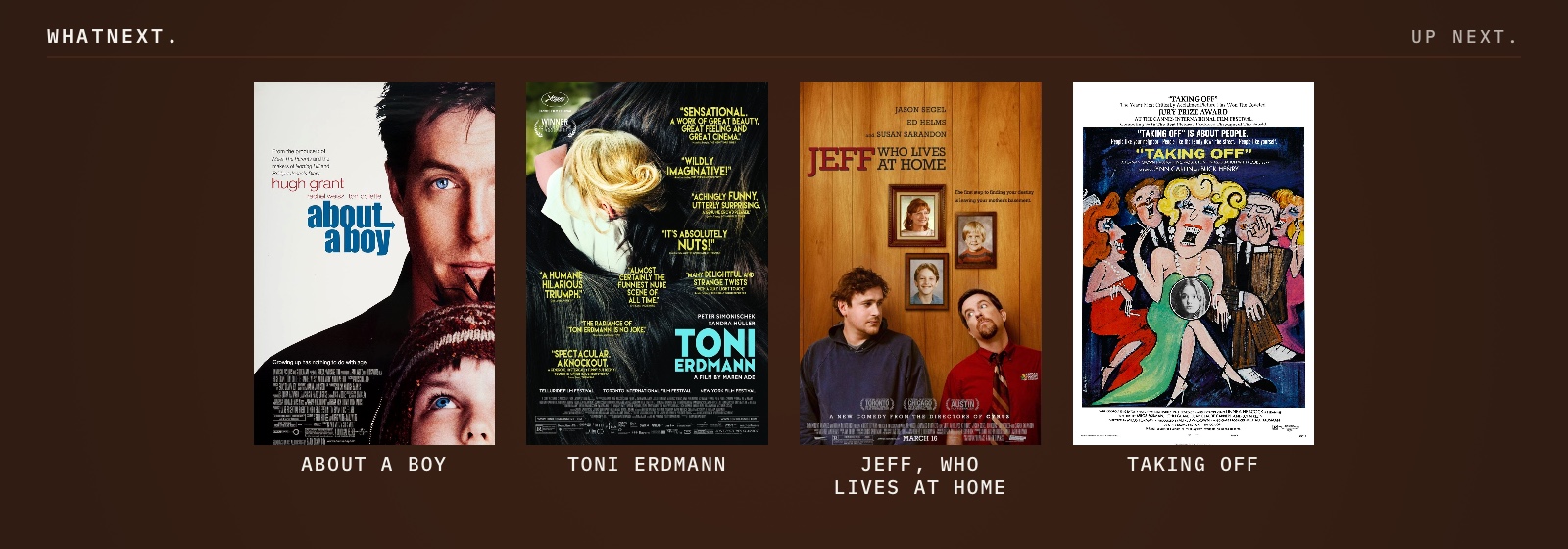
Once the credits rolled, I ran Club Kid through WhatNext.'s recommendation engine to see what else lives in that same comedy-drama neighborhood (picking Jeff, Who Lives at Home over 29th Street for a tighter tonal and family-dynamic fit). Here are the four matches it surfaced:
About a Boy (2002) pairs sharp humor with an unlikely adult-kid bond that forces its protagonist to grow up without turning him into a saint overnight. Chris and Paul Weitz's London comedy-drama stars Hugh Grant as Will, a wealthy, aimless bachelor whose carefully insulated life is upended by a precocious 12-year-old boy (Nicholas Hoult) and his struggling mother (Toni Collette).
Toni Erdmann (2016) shares Club Kid's knack for turning cringe-inducing chaos into something unexpectedly moving. Maren Ade's acclaimed German comedy-drama follows an eccentric retired music teacher (Peter Simonischek) who tries to reconnect with his tightly wound, career-driven daughter (Sandra Hüller) by crashing her corporate life in outlandish disguises.
Jeff, Who Lives at Home (2011), directed by Jay and Mark Duplass, brings a similar mix of slack-paced comedy and warmth around messy, imperfect men. It follows an aimless man-child (Jason Segel) who finally leaves his mother's (Susan Sarandon) basement for an erratic daylong errand with his estranged, tightly wound brother (Ed Helms).
Taking Off (1971), Miloš Forman's first American feature, turns that same wry, empathetic eye toward adults stumbling through roles they are completely unprepared for. Lynn Carlin and Buck Henry star as suburban New York parents whose teenage daughter (Linnea Heacock) runs away, pulling them into the bewildering world of 1970s youth culture.
If you want one more in the same vein, Mike White's Brad's Status (2017), starring Ben Stiller and Austin Abrams, offers another wry, tender look at fatherhood and midlife doubt during a father-son East Coast college tour.