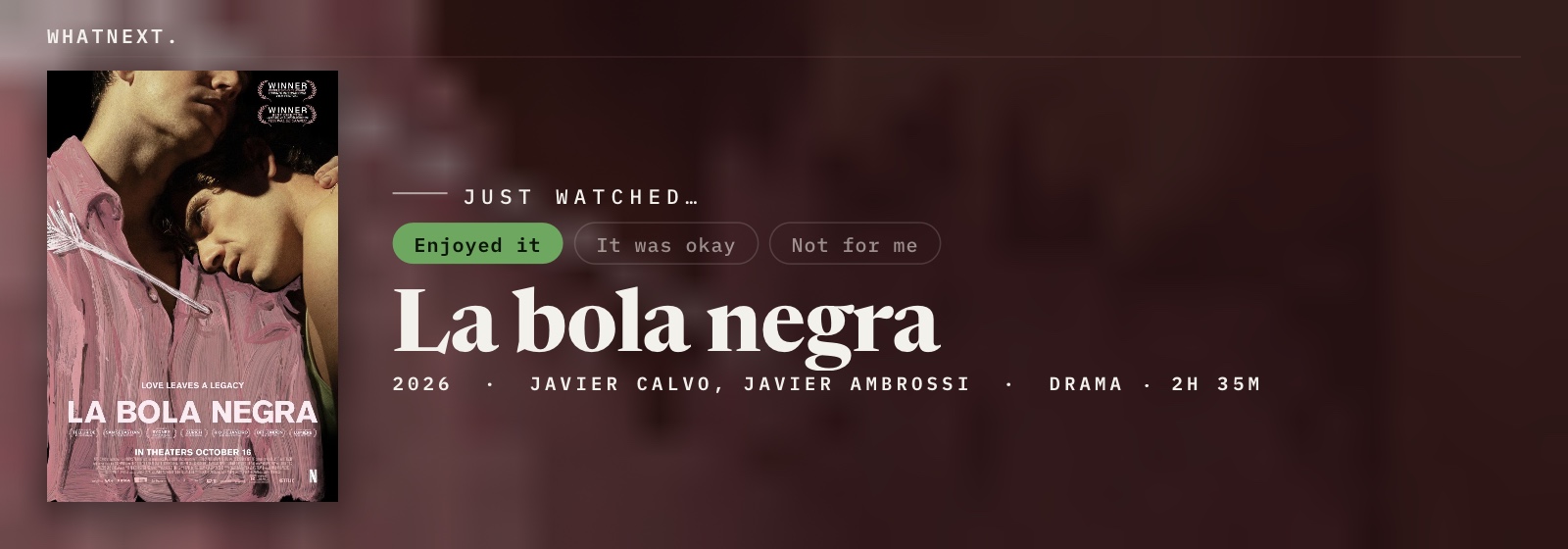
Javier Calvo and Javier Ambrossi's La bola negra (2026), released internationally as The Black Ball, takes an unfinished final fragment by legendary Spanish poet Federico García Lorca and expands it into an ambitious, multi-generational queer historical epic. Co-written with playwright Alberto Conejero and drawing from his stage piece La piedra oscura, the film weaves between three distinct eras in Spanish history: an elite social club in 1932 on the eve of political transformation, a makeshift military hospital during the Spanish Civil War in 1937, and contemporary Madrid in 2017. Winning the Best Director Award at the 2026 Cannes Film Festival before being selected as Spain's official entry for the 99th Academy Awards, the film approaches heavy historical grief with rare visual grandeur and lyrical intimacy. Walking into the theater completely blind, I was struck by how effortlessly its expansive canvas holds space for quiet, deeply personal human yearning.
What Worked
The acting is stellar across the board, populated by characters that feel deeply rich and lived in. Singer-songwriter Guitarricadelafuente (Álvaro Lafuente) delivers a remarkable acting debut as Sebastián, capturing the quiet torment of a young Nationalist trumpeter forced to conceal his sexuality behind military discipline. Opposite him, Miguel Bernardeau is profoundly moving as Rafael Rodríguez Rapún, Lorca's real-life partner and secretary who was held as a Republican prisoner of war before his death in 1937. Bernardeau brings tragic dignity and gentle defiance to every exchange. In a brief but indelible turn, Penélope Cruz delivers her second standout performance of the year, following The Invite. As Nené Romero, a pre-war cupletista performing for weary soldiers, Cruz radiates warmth and defiance, reminding both the characters and the audience of an expressive artistic freedom that existed before the war tore it apart.
What makes the 1937 timeline so striking is how it frames the central connection between Sebastián and Rafael. To call it a standard romance would feel inaccurate, because a conventional romance could never genuinely exist under the crushing pressure of both the era and the war. Instead, it is an intimate connection and magnetic pull between two people on opposite sides of a violent ideological divide who discover solace and shared vulnerability in each other. Their bond is charged with unmistakable longing and desire, yet forever shadowed by the reality that their private sanctuary is borrowed time.
Visually, Calvo and Ambrossi have crafted a gorgeous piece of filmmaking. The cinematography makes extraordinary use of natural darkness, striking framing, and sun-scorched vistas that feel wholly immersive. Whether lingering in the claustrophobic shadows of a wartime hospital barracks or capturing the grandeur of the Spanish countryside, the camera moves with deliberate confidence. The film handles its massive historical backdrop without ever drowning the viewer in dense textbook exposition. You feel the crushing weight of the conflict in the mud, the tension in the room, the fear in each glance, and within the characters themselves, communicated through both what is spoken and what remains unsaid.
At its core, La bola negra is an expansive examination of yearning, shame, repressed identity, and the suffocating performance of traditional masculinity, witnessed through the lives of three queer men across Spanish history. It manages to feel massive and operatic while remaining tender and personal. From the opening scenes, the story is sad and tragic: you understand early on that this journey is not heading toward an easy happily-ever-after. Yet the deliberate pacing allows you to sit with these people, breathe in their world, and absorb their journey. When the narrative threads converge at the end, the closing revelation lands with an unexpected emotional punch that recontextualizes everything that came before.
What Didn't Land
If there is a flaw in the film's three-part structure, the modern 2017 storyline is the weakest link. That distinction is strictly relative: Carlos González gives a fine performance as Alberto, a contemporary historian untangling his family's buried past, and the era provides necessary thematic bookends to modern Spanish memory. But compared to the life-or-death urgency and emotional heat of 1937, or the high-society prejudice of 1932, the modern chapter occasionally feels like it is treading water.
In particular, the emotional rift between Alberto and his mother Teresa (played by Lola Dueñas) resolves somewhat abruptly. The film spends considerable time establishing their strained communication and generational misunderstandings, only to reach an emotional reconciliation without a clearly articulated catalyst. While family forgiveness often happens quietly without a single dramatic turning point, in a narrative so meticulously composed, their sudden accord feels slightly unearned compared to the earned weight of the earlier timelines.
Final Thoughts
Going into La bola negra completely blind with zero expectations, the film blew past anything I could have anticipated. It is a rich, beautifully composed tapestry of stories you expect to connect, and the journey is deeply rewarding. Even with minor narrative lulls in its contemporary thread, the sheer visual craftsmanship, stellar ensemble work, and moving tribute to Lorca's lost voices make it unforgettable. When I logged my initial reaction on TikTok, I gave it an enthusiastic "Enjoyed it" verdict, and that admiration has only grown as its final images continue to linger.
Stray Observations
- What was the deal with that Italian soldier? He acts noticeably protective of Sebastián on multiple occasions, yet the exact history or motivation behind his watchful loyalty is left completely unexplored.
- The film does a great job staging its drama against the Spanish Civil War without burdening the viewer with dry political exposition. Learning afterward that Rafael Rodríguez Rapún was an actual historical figure (Lorca's secretary, actor in La Barraca, and an athlete who died fighting in 1937) adds staggering real-world grief to his final conversations.
- There also seemed to be an unspoken neutrality among the sisters working in the hospital, observed mostly through their gentle interactions with Rafael. They never treated him as the enemy (which makes sense given that a civil war is an internal tragedy), and one sister even remarked on how nice he was to Sebastián.
- There is a fair amount of frank nudity throughout, fitting the film's unvarnished approach to male vulnerability and physical intimacy.
- While Carlos's (Milo Quifes) fate in the 1932 timeline seems clear through the cruel rejection of the titular black ball, the film leaves just enough poetic ambiguity around his final moments to keep you turning it over in your head.
If You Liked This, Try These
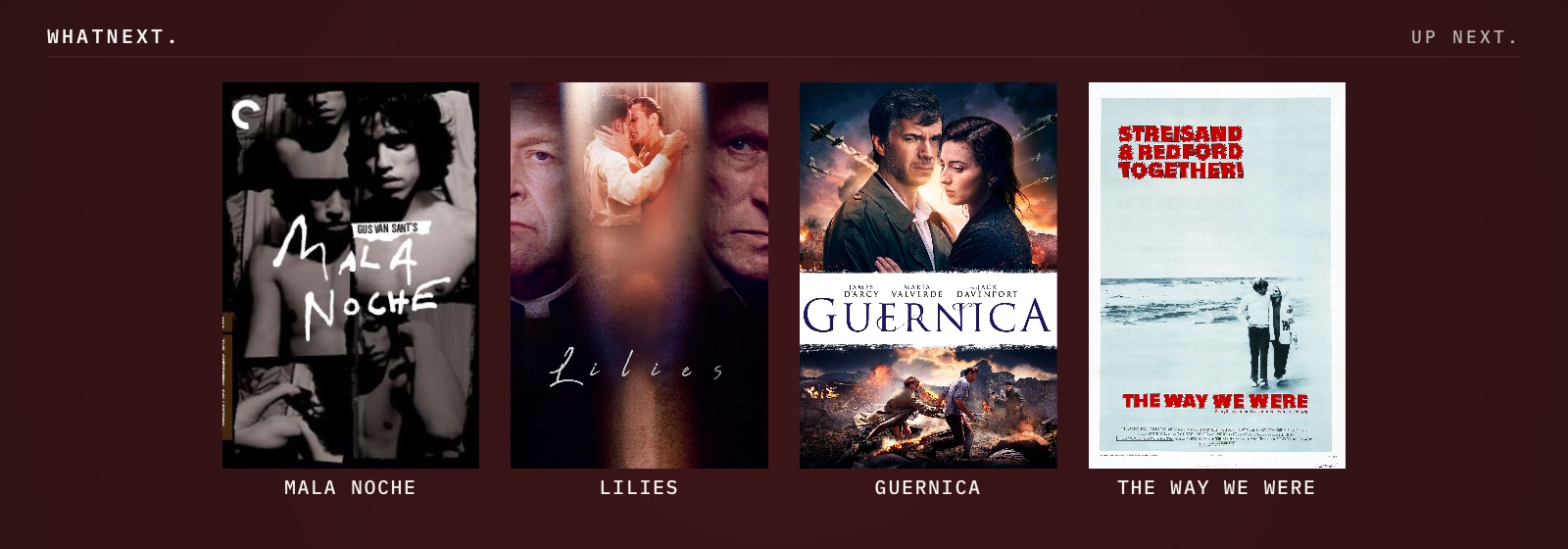
WhatNext.'s recommendation engine seeded directly from La bola negra, searching across the catalog for films that capture poetic queer longing, wartime intimacy, and the lingering weight of historical memory. These four selections reflect different facets of that emotional landscape:
Mala Noche (1985) is Gus Van Sant's raw, lyrical debut exploring unrequited queer desire and marginalization on the rain-soaked streets of Portland. Shot in gorgeous, high-contrast monochrome, it shares the same stark visual intimacy and ache of longing that pulses through Sebastián's wartime story.
Lilies (1996), directed by John Greyson, also stages an operatic, multi-timeline queer tragedy against a backdrop of confinement. Set in a Canadian prison where inmates stage a play about a fateful 1912 romance and institutional betrayal, it mirrors the theatrical heritage of Lorca and Conejero with lush, dreamlike melodrama.
Guernica (2016) grounds its romance directly in the Northern front of the Spanish Civil War. Koldo Serra's drama captures the devastating aerial assault on the Basque city, weaving personal affection through the chaos and censorship of wartime journalism with grand period scale.
The Way We Were (1973), Sydney Pollack's celebrated romantic drama starring Barbra Streisand and Robert Redford, demonstrates how passionate personal devotion struggles against ideological divides. Like Sebastián and Rafael, its lovers discover an irresistible private connection that ultimately cannot withstand the political currents of their era.
For another rich examination of love and lost correspondence across separated timelines, Augustine Frizzell's The Last Letter from Your Lover (2021) makes a bittersweet companion piece. During curation, the recommendation engine's period pools also surfaced strong similarity scores for Michael Grandage's My Policeman (2022) and Héctor Babenco's Kiss of the Spider Woman (1985), showing how cinema continually returns to the quiet tragedy of words left unsaid.