
Alejandro González Iñárritu's Digger (2026) is a difficult film to rate. Arriving in theaters after a deliberately secretive promotional campaign, it tries to deliver an enormous amount of biting social commentary all at once. What begins as a broad ecological farce about Digger Rockwell (Tom Cruise), an unhinged oil magnate whose drilling in Greenland unleashes a global catastrophe, soon fractures into something stranger and more self-aware. Without giving away how the narrative unfolds, an early structural shift begins blurring the line between reality and cinematic performance. It is a massive, polarizing swing, and while you have to admire the sheer scale of the ambition, the finished product struggles under the weight of its own chaotic ideas.
What Worked
The formal mechanics behind the film's central conceit are genuinely compelling. The heightened absurdity feels jarring during the opening minutes, but once the movie establishes that the heightened tone is a deliberate, baked-in layer of the storytelling, the pieces click together. Iñárritu handles the fluid boundary between reality and fiction with real visual craft. A sequence will begin with complete cinematic earnestness, only for the camera to slowly pull back or shift perspective, exposing the artifice and letting the seams of the narrative show.
The film also benefits from a rich, inventive score composed by Cosmo Sheldrake. Rather than settling for conventional orchestral melodrama, the music provides a playful, eccentric counterweight that keeps the proceedings vibrant even when the narrative begins to drift.
In front of the camera, the performances deliver plenty of spark. Tom Cruise takes on a role diametrically opposed to his usual heroic star persona, tackling an eccentric, multi-layered challenge: peeling back the vanity of an unhinged industrialist while playing with the meta-commentary of performance itself. It is a scene-chewing, volatile turn that shows a rare willingness to look foolish. The standout of the entire ensemble, however, is Riz Ahmed as Dr. Nirav Ganesh. Ahmed displays remarkable range, charting a believable transformation from the meek, bumbling safety scientist who first appears on screen into the completely unfettered, drunken truth-teller who later unravels in front of everyone. It remains unmistakably the same man throughout, but Ahmed modulates his body language and vocal cadence so naturally that the shift feels grounded and authentic.
What Didn't Land
Where Digger runs into trouble is in its tonal control and comedic precision. The movie clearly aims for the acidic, surreal absurdity popularized by filmmakers like Yorgos Lanthimos in Poor Things, yet it lacks that exactness of vision. Instead of razor-sharp surgical strikes, the humor often feels blunt, frantic, and painfully unfunny. While a few isolated gags elicited chuckles in my theater, like a running physical bit where characters repeatedly trip over a misplaced shovel, or a dry joke about minding language in front of "the ladies" when the room consists entirely of elderly white men, too many comedic setups fall flat. A protracted, absurd gag involving a stuffed cat in the opening stretch lands with a thud and sets an uneasy precedent for the rest of the runtime.
The script also bites off vastly more thematic material than it can chew. Over its lengthy runtime, the story takes frantic aim at every contemporary target within reach: corporate greed, political incompetence, digital media distraction, and the corrupt symbiosis between private enterprise and government regulators. Because the film never stays in one place long enough to dissect any single institution, the commentary ends up feeling shallow and scattered.
A lingering subplot involving a desperate search for a missing daughter feels especially marooned from the broader satirical machinery. While its intended purpose might have been to illustrate the absurd, almost limitless reach and private resources of the ultra-wealthy elite in a crisis, the thematic connection is so tenuous and murky that it ends up feeling like an unresolved detour rather than a meaningful critique.
There are flashes of sharp observation that suggest what could have been. In one striking scene, Cruise's tycoon turns on his critics, arguing that while society loves to demonize the extraction of fossil fuels, everyone remains utterly dependent on the modern conveniences oil provides. It is a genuine, provocative point that cuts through easy hypocrisies, yet the screenplay drops the thread almost immediately to chase the next chaotic spectacle.
This lack of narrative economy hurts the pacing severely as the runtime wears on. In the middle stretch, individual sequences frequently go on for far too long seemingly without a clear dramatic purpose, exhausting their initial premise before finally moving forward. Rather than building momentum, the scenes loop back on themselves, leaving the film dragging heavily through its midsection.
Final Thoughts
I did not hate Digger, but I cannot say I enjoyed it either. It lands squarely in "not for me" territory, erring closer to dislike than a recommendation. There is undeniably a provocative, audacious movie buried beneath the clutter, and I respect the nerve it took to mount a high-budget theatrical experiment this odd. But without sharper comedic timing and a disciplined thematic focus, the film becomes a bloated, exhausting watch. While this movie wasn't for me, others who appreciate wild, maximalist swings and don't mind a meandering pace may connect with it more.
Stray Observations
- The practical logistics of the setting fall apart rapidly if you scrutinize them, so it is best to treat the geography as purely expressionistic.
- I saw this in a premium large format screening, and the sound mix felt punishingly loud at multiple points, a sensory overload that seems to be an escalating trend for modern theatrical releases.
- Given the sheer volume of narrative misdirection and tonal whiplash, this film feels almost impossible to market effectively, so audience expectations were undoubtedly all over the place heading into opening weekend.
- Several heavyweight performers feel underutilized by the screenplay, notably Sandra Hüller and Emma D'Arcy, who are given surprisingly little substantive material to work with despite their prominent billing.
- John Goodman and Michael Stuhlbarg portray the executive administration as cartoonish bumblers, which may test viewer patience, though given the surreal nature of modern politics, it might be uncomfortably accurate.
What to Watch Instead
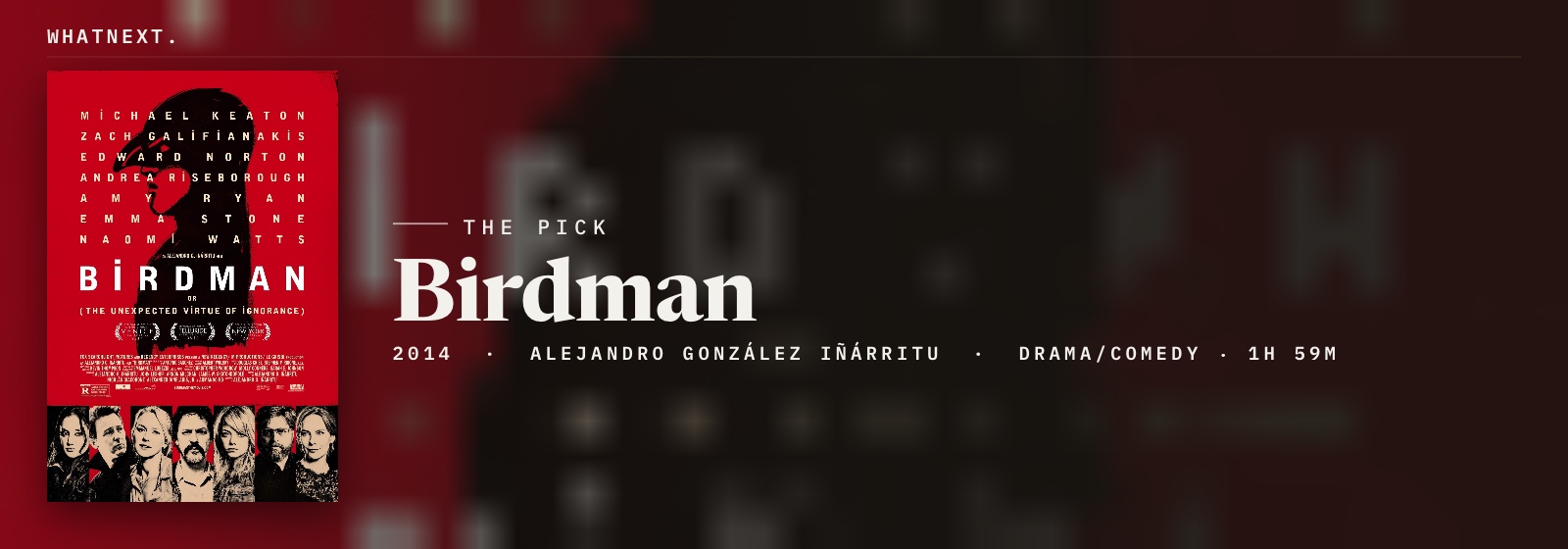
If you want a backstage satire about artistic desperation, creative ego, and public unraveling that operates at full throttle without losing control, watch Alejandro González Iñárritu's own Birdman (2014).
Birdman follows an aging Hollywood star (Michael Keaton) attempting to resurrect his artistic credibility by staging a demanding Raymond Carver adaptation on Broadway. Iñárritu uses fluid, unbroken camerawork here as well, but every manic flourish serves a tightly focused character journey. Backed by Antonio Sánchez's propulsive jazz percussion and razor-sharp turns from Edward Norton and Emma Stone, Birdman captures the claustrophobia of the theater world while remaining consistently funny and emotionally grounded. It is Iñárritu firing on all cylinders, demonstrating how thrilling his maximalist style can be when anchored to a disciplined script.
If You Liked That, Try These

Seeding directly from Birdman, WhatNext.'s recommendation engine pulled four sharp, dark dramedies centered on fragile masculinity, eccentric outsiders, and the grueling costs of performance:
The Wrestler (2008) strips away glamorous showbiz pretension to document the physical toll of athletic showmanship. Mickey Rourke delivers an unforgettable, bruising performance as Randy "The Ram" Robinson, an aging performer struggling to accept that his spotlight has faded. Like Birdman, Darren Aronofsky's film treats the psychological weight of performance with unsparing emotional honesty.
American Splendor (2003) blurs the boundaries of reality and fiction with singular comedic inventiveness. Starring Paul Giamatti as curmudgeonly comic book author Harvey Pekar, Shari Springer Berman and Robert Pulcini's film mixes dramatized scenes with appearances by the real-life subjects and animated illustrations. It captures everyday existential frustration and creative impulse with genuine wit.
The Late Show (1977) stars Art Carney as an aging, worn-down private eye navigating a strange, sunbaked California underworld alongside an eccentric client played by Lily Tomlin. Robert Benton's witty neo-noir blends gritty mystery beats with offbeat comedic timing, exploring bruised professional pride and changing eras with immense charm.
A Different Man (2024) is a surreal, acidic satire about identity, insecurity, and the performative nature of modern art. Sebastian Stan plays an aspiring actor who undergoes radical medical treatment to alter his facial appearance, only to become obsessed with another man starring in a stage play based on his former life. It is strange, funny, and deeply cynical about artistic commodification.
For another dive into the creative ego spiraling out of control, Barton Fink (1991) offers a masterclass in claustrophobic Hollywood satire and artistic dread.