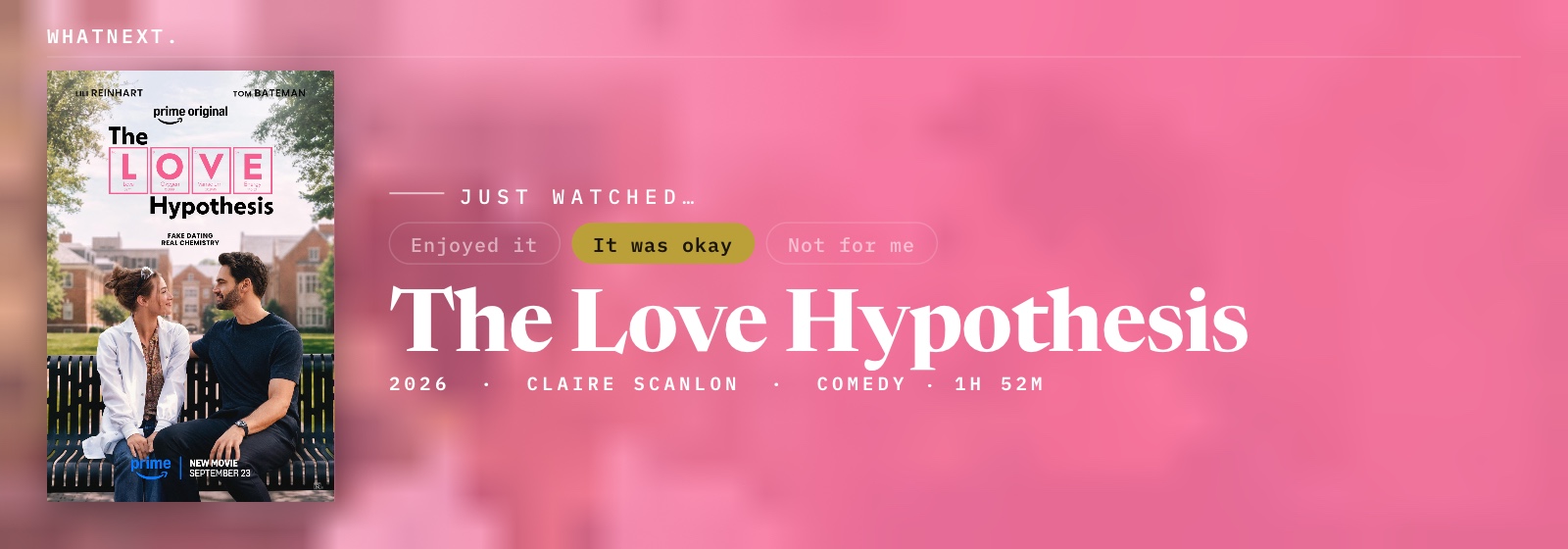
Claire Scanlon's The Love Hypothesis (2026) arrives with a ready-made audience, adapting Ali Hazelwood's bestselling STEM romance novel. I haven't read the novel, so I came into this purely as a film viewer taking the story on its own cinematic merits. Lili Reinhart stars as Olive Smith, a third-year biology PhD candidate at Stanford who impulsively kisses the first man she encounters in a dark hallway to convince her best friend that she has happily moved on with her dating life. That stranger turns out to be Dr. Adam Carlsen (Tom Bateman), a notoriously harsh and feared young professor. Facing his own institutional pressures to demonstrate roots at the university so his research funding stays unblocked, Adam agrees to maintain the fake-dating charade. What begins as a calculated contractual pretense between two scientists gradually blurs into something genuine.
What Worked
Where the film succeeds most consistently is not in its titular romance, but in the supportive warmth of its central friendship. The chemistry between Olive and her best friend Anh (Rachel Marsh) is delightful, grounded in real camaraderie and mutual respect. Too many contemporary romantic comedies feel compelled to manufacture petty rivalries or toxic jealousy between female friends, so it was genuinely refreshing to watch a story where Olive and Anh simply adore and back each other up without artificial tension. The dynamic extends naturally to Anh's relationship with Jeremy (Nicholas Duvernay), giving Olive's social circle an easy, lived-in charm.
Olive's initial motivation also makes good emotional sense. Faking a romance so her best friend feels free to pursue a guy Olive once had a harmless crush on feels like an act of genuine, albeit misguided, loyalty (for anyone who watched early seasons of One Tree Hill, it is the mature, unselfish resolution Brooke Davis and Peyton Sawyer always deserved). When the story sticks to light, low-stakes campus routines and the middle-stretch contract negotiations, it functions as an easy, breezy streaming watch that goes down smoothly without demanding much from the audience.
What Didn't Land
Despite those bright spots, the film stumbles under severe structural issues and tonal miscalculations that constantly undercut its own charm.
The story feels comfortably low-stakes until a late-act turn introduces a jarring high-stakes conflict. Without spoiling the specifics, an external academic threat suddenly puts Olive's entire research career on the line, pulling what was otherwise light, breezy comfort viewing into a much darker, predatory corner. It is an abrupt tonal whiplash that the lightweight script simply isn't equipped to handle gracefully.
Lili Reinhart has undeniable natural charm, but the screenplay traps her in frustrating passivity. Throughout much of the runtime, things merely happen to Olive rather than being driven by her own active agency, like having zero backup plan when her initial lab funding falls through. Worse, the dialogue between the two leads struggles whenever the script reaches for emotional weight, regularly curdling into cringey, overwritten clichés. Romantic comedy resolutions inherently traffic in cheese, but selling that cheese requires dialogue that feels human and earned; here, the writing during the climactic reconciliation scene between Reinhart and Bateman is so painfully stiff and melodramatic that it takes you right out of what should be the film's emotional peak.
The setup on Adam's side makes even less sense: the idea that a university department needs to see a professor playing house on campus to believe he has "roots" to keep his grant money is laughable. In reality, awarding a researcher a massive grant is what anchors them to an institution, not a staged campus fling. Add in Tom Bateman playing Adam as comically evil and stiff in the opening act, early negative chemistry that takes far too long to warm up, an unearned ghosting arc after the conference, and an opening bathroom meet-cute that the plot completely forgets to ever meaningfully pay off, and the story strains under its own contrivances.
Final Thoughts
I don't regret watching The Love Hypothesis. If you queue it up on a quiet evening looking for easy, unchallenging background viewing, it goes down smoothly enough, and Reinhart's friendship with Anh supplies genuine sweetness. But a romantic comedy cannot run on friendship alone. When the romance itself is weighed down by clunky dialogue, awkward early chemistry, and jarring tonal swings, the experience tops out as a gentle shrug. It sits squarely in "it was okay" territory: passable comfort viewing, but fundamentally mediocre.
Stray Observations
- I really appreciated how Rachel Marsh, playing Anh, subtly foreshadowed that she saw through the fake-dating charade all along, planting small observational glances so the eventual reveal felt earned rather than like an unearned twist.
- I spent the entire promotional rollout genuinely convinced the male lead was played by Tom Ellis. It was only days before watching that I realized it was Tom Bateman, because the visual resemblance between the two is uncanny.
What to Watch Instead

If you came away from The Love Hypothesis craving a modern romantic comedy with effortless banter and real screen presence, try Claire Scanlon's own 2018 film, Set It Up.
Set It Up pairs Zoey Deutch and Glen Powell as two severely overworked assistants in New York who conspire to set up their demanding bosses (Lucy Liu and Taye Diggs) just to buy themselves some free time. Scanlon directs both films, but Set It Up works because it doesn't need to lean on a contrived fake-dating gimmick to generate heat. The chemistry between Deutch and Powell is there from their very first scene, the workplace exhaustion feels painfully authentic, and the script trusts its characters to be witty, capable adults rather than passive passengers in their own romance. It is one of the best contemporary rom-coms and a good fix if The Love Hypothesis left you underwhelmed.
If You Liked That, Try These

Rather than digging through the catalogue for more half-hearted fake-dating tropes, WhatNext.'s recommendation engine seeded directly from Set It Up, surfacing four smart, sharp romantic comedies built on genuine connection and witty comedic timing:
Crossing Delancey (1988) is a quintessential New York romantic comedy about an independent uptown bookstore clerk whose traditional grandmother hires a matchmaker to set her up with a neighborhood pickle vendor. Like Set It Up, Joan Micklin Silver's film runs on sharp urban texture, authentic charm, and two leads who discover genuine warmth beneath surface differences.
A Touch of Class (1973) earned Glenda Jackson an Academy Award for a reason: her razor-sharp, screwball-paced rapport with George Segal makes a messy, complicated affair feel sharp and alive with intelligence. It avoids easy sentimentality in favor of witty, sophisticated adult friction.
The Goodbye Girl (1977) pairs Richard Dreyfuss and Marsha Mason as reluctant apartment sub-tenants forced to share a cramped Manhattan living space. Neil Simon's sharp script lets their mutual annoyance evolve naturally into earned affection, proving how effective romantic friction can be when anchored by top-tier comic timing.
Materialists (2025) explores modern romantic compromise against high-stakes social expectations in contemporary New York. Celine Song crafts a mature, observant dynamic that examines how financial reality and genuine emotional desire collide, trading rom-com contrivances for nuanced character drama.
For another slow-burn romance, You've Got Mail (1998) remains a timeless benchmark for watching two people gradually realize how well they fit together.